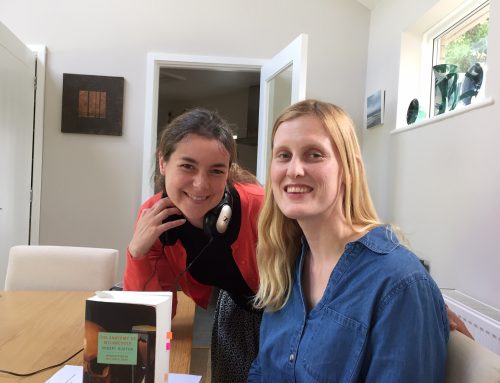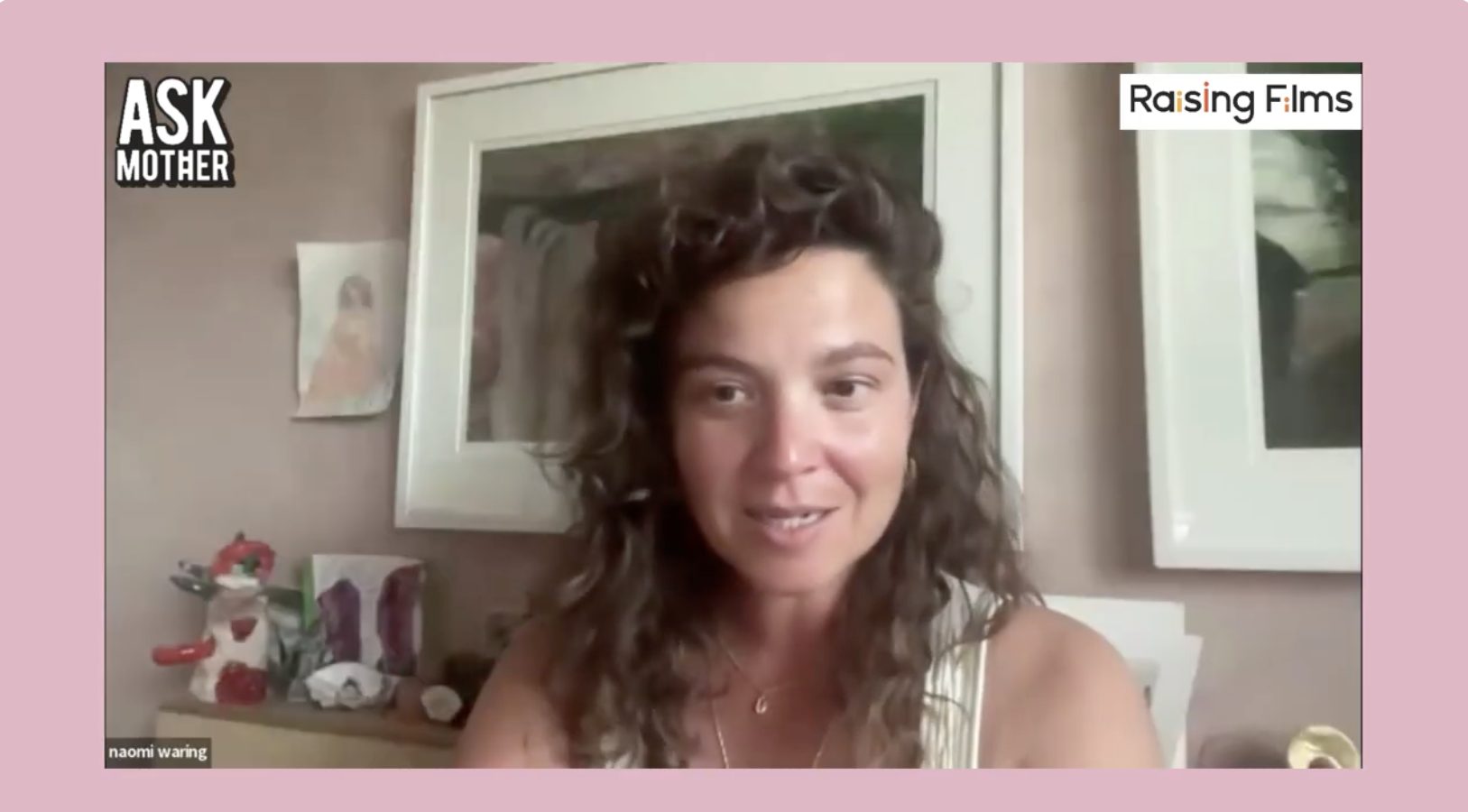
We were so delighted to partner with Elinor Coleman of Ask Mother Productions on the first of a series of online talks about caring responsibilities and making work for the screen. Elinor talked to Northern Irish filmmaker Naomi Waring in early July. You can watch the full talk here or read the transcript below (edited for clarity).
Ask Mother (AM): I’m sure some of you are doing bedtimes, doing, you know, making dinner, whatever. So feel free to drop in and out if you’re busy, if you’re, you know, you can listen to this as a podcast, you can engage with it however you want to. If you need to leave, come back in, whatever you like. It’s very relaxed here. So make yourselves at home. We’re going to have a nice chat with Naomi very shortly. And if anybody has any questions for her, if anything comes up while we’re talking, we’re going to do a Q&A at the end of the session, so you can either pop it in the chat, or when we get to that, you can come off.
AM: So, welcome! My name is Elinor, I am the founder of Ask Mother. We’re a platform that seeks to celebrate and connect mums who are working in the creative industries, across the creative industries. And, I can see two Jennifer Middletons there, that’s really trippy, amazing. And so this is our first ever talk and we’re super, super excited, and what I’m going to do is spotlight myself so you can see me bigger. I’m sure that’s what everybody wants to see. We are presenting this talk in partnership with Raising Films, who I’m sure many of you know, they’ve been working for 11 years, correct me if I’m wrong, Jessica, a good long time supporting parents in the screen industries. And we’re super, super happy that they were so keen to partner with us on this. And so, before we introduce Naomi, I’m just gonna invite Jessica to come and have a little chat and introduce Raising Films for anybody who doesn’t know them.
Jessica Levick (JL): So, hello, everyone. My name is Jessica Levick, and I’m one of the co-founders of Raising Films. For those of you who don’t know us we support and campaign for parents and carers in the UK screen industries. We do this by conducting research, celebrating good work, and offering training and residencies, which we’ve been working on for a long time. We conducted the first ever survey into the impact of caring on the careers of filmmaker parents back in 2015.
We also have branches in Australia and Ireland, and we were awarded a BIFA Special Jury Award in 2021 for our work. We know how crucial community is to parents and carers, and in the past, we’ve held get-togethers around issues like preparing to shoot over the summer holidays, and gatherings at film festivals to help parents still access professional spaces when they might be feeling left out.
But today, we’re so pleased to be here to support Elinor Coleman of Ask Mother, in her new series of online chats with inspiring parents and carers who are generously sharing their experiences of how they make it possible to have a career in the screen industries.
If you’re here because you are parents and carers looking for inspiration, we’d love to invite you to take a look at our website, raisingfilms.com, where there are a lot of interviews with brilliant people who found ways to make it work, case studies of productions where they accommodated caring responsibilities.
Resources telling you what your rights are as an employee and your responsibilities as an employer, and lots of data you can look at to understand how we as an industry are doing.
Finally, if you know any brilliant people, organisations or companies who are doing great work in making their workplaces accessible for parents and carers, we’d encourage you to submit them for a Raising Films ribbon, which is a kite mark that tells everyone what people and companies are doing out there to change our culture for the better.
And now, over to Elinor and her special guest for tonight, filmmaker Naomi Waring. Naomi participated in a Raising Films event back in 2016 at the Edinburgh Film Festival, so it’s going to be brilliant to hear about her career since then, and how she made her short film Milk while juggling the demands of being a parent.
So thank you, Elinor, so much for setting us this all up. And over to you.
AM: Thank you so much, Jessica. And yeah, a huge thank you to Raising Films because you’ve been super, super supportive with this. So without further ado, I am about to welcome the wonderful Naomi Waring, who I’ve had the pleasure of knowing for a number of years, and I’ve been an absolute fangirl of her for the length of time that I’ve known her.
Naomi is a screenwriter and director whose work explores class, identity, belonging and contemporary social issues through intimate, character driven storytelling. Most recently, she directed Privileged for BBC three and BBC iPlayer, produced by Out of Orbit and Northern Ireland Screen as part of BBC Writers Room Long Story Short Initiative. The film is currently nominated for a Broadcast Award.
Her short film Milk, which hopefully many of you have seen by now, and if not, we’ll come to that, was executive produced by Sienna Miller and supported by the Uncertain Kingdoms Belief Fund. It was nominated for a London Critics Circle Film Award 2026 Vocal Warm-Ups and was the winner of the 225 Film Club Audience Award. She’s currently developing her debut feature film, Drifters, which was selected for the prestigious Less is More development program in 2025, and hopefully she will tell us more about that later as well. So please welcome Naomi Waring!
Naomi Waring (NW): Woo. Wow. Thanks. It’s a bit of a mouthful, that bio.
AM: I didn’t do my warm-ups. I should have done them, and I didn’t do them, so never mind. I hope I did you justice, because you’ve got a lot of things to say. There’s a lot to be said about you. Thank you. What I didn’t say about you there is that you’re also an absolute powerhouse of a single mother. Which we’re gonna get into, but I feel like that should be in your bio as well, because it’s, as a fellow single mother, a whole lot of work, a whole other job. I’m sure there’s lots of other people on the call who would agree with that too.
NW: I have to say, though, I have been very lucky in the fact that I am a single mum, but I actually would say that I’m a co-parent. And I think that it comes with its own challenges, but there definitely is a bit more of a privilege and space that I’ve been able to occupy, which I know is not the same for you and for many other single mums. So yeah, I am very lucky. My son’s father is very present and in his life, so I don’t know how much I would have been able to do if that weren’t the case.
AM: Good, a good, a good dis.. not disclaimer, but good, like point.
NW: Yeah. Very different when you’re doing it solely on your own.
AM: I would love to just take us back to the beginning of your career, your story, and find out what was it that first drew you to filmmaking? When did you realize that it was something that you wanted to build your life around?
NW: Thanks. Well, actually I started out as an actor many, many years ago. I went to theatre school from a very young age and I was lucky enough to get sort of scholarships to go to Sylvia Young and then Webber Douglas. And I was incredibly passionate about the work that I did there in that training. But when I left, drama school, I very quickly became a mum and I was very naive in, thinking that, you know, I’d just be able to continue working and, you know, bring the baby along with me, but actually so much of my identity shifted when I became a mum.
And priorities changed and actually I just wasn’t able to, to do the work a lot of the time. I remember at one point kind of juggling a part-time job at the Groucho Club whilst breastfeeding still and doing a rehearsal for a fringe play. And I, it was, it was from that struggle and from that change in circumstance and also perspective that kind of led me to really wanting to make my own work. I think being an actor can sometimes feel like a very passive thing to do, and I really wanted a way to kind of take control in my own time, in my own way. And so I wrote a film that I was in and I produced, but I didn’t direct, and it was really bad, obviously, it was terrible.
It was from that struggle and from that change in circumstance and also perspective that kind of led me to really wanting to make my own work.
But it was from then that made me understand that I wanted to make films, and I wanted to make really brilliant films, and I wanted to get good at that. And, that was at the point where I actually did separate from my partner and I moved to Wales in the middle of winter with a friend kind of going through early motherhood and a lot of self-doubt and we made a shadow puppet show together and it was this kind of small act of creativity to kind of give ourselves some kind of sense that we could carve out a bit of time for ourselves together.
And it really raised my confidence, and at the time of doing that, I made it as a documentary along with another, filmmaker called Joanna Coates and that’s when things really sort of started to grow and my confidence in myself and storytelling grew. So really, it came from motherhood, you know, the desire to make films came from a place of wanting to have more autonomy and wanting to be able to do things in my own terms, in my own way.
And, you know, for the past 12, well, a bit longer than that now. I was 28 when I made my first film. I’m 42 now. For that time, I’ve been really trying to develop my own voice and my own perspective and point of view. And I’ve been doing it fairly slowly, but quite rigorously for that amount of time, because I haven’t been able to really sort of have a career in the film industry as such. But I feel quite lucky, in a way, that I have had that time to really develop as a… as an artist and as a creative. So really having that kind of barrier has, given me opportunity to kind of grow in a way that I don’t think that I would have done had I not become a mother so young.
AM: That’s a really nice kind of way of looking at it, I think, that kind of, like, motherhood sort of put you in a bit of a… a cocoon, in a way, like, where you… you… you can… you’ve still been creating work, and you’ve been developing yourself, and I mean, I’ve… I’ve said this about you, I really feel like in the last few years, things really seem to be ramping up for you. And, you know, I’m gonna come to this later, but I think it’s no coincidence the fact that your son is now at such an age where he’s kind of… flying the nest this year?
NW: Yeah, he’s gonna be 18 on Sunday, which is a whole, other world of pain. But, no, I don’t, I don’t think it’s a coincidence, and… but also, it’s, it’s… I guess Sunny and I have grown up together in a way, and so, it’s not… I don’t think it’s just the fact that I have more time and space to myself, but it’s more that I’ve had that time to develop, if that makes sense. It sort of makes sense that it’s now, because I’ve put so much work in, and we talk about those 10,000 hours, or 100,000 hours, or whatever it is. I’ve certainly done more than that, you know, I’ve made over 15 films, whether that’s for other people, or, you know, charities, or communities, and, you know, I’ve really sort of been doing that all underground. And then, in the last couple of years I began to feel quite frustrated at not really being able to make longer form work and and now is the time that I can do that. So yeah, Sunny is off to New Zealand and I’m definitely going to need to get a hobby or some way to fill that time and yes, so I think those 2 things have gone hand in hand. Having the time and, and feeling a little bit less guilty, really,
I think we’ve sort of talked about it before, of, like, this idea that the work that we do, it’s sort of a selfish act in a way, or it can feel quite selfish to need to create, like, it’s not just like a, you know, like, I want to be a filmmaker, like, I need to do that, like, and if I don’t do that, and I don’t give myself the space and time to do that I’m not a very good person to be around.
But as we know, like, that’s not necessarily always seen, always recognized, always paid form, that time, and it can really amount to nothing, you know, on an external point of view. And so taking that time in the past, when Sunny has been younger, was a huge guilt factor, just knowing that it, you know, it might amount to nothing. And yeah, I guess I have less of that now because he just doesn’t want to hang out with me.
AM: There’s a bonus then. But I was thinking about that, like, the guilt that we have, and it’s such a good point that the fact that so much of what we do is kind of… you don’t know that it’s going to be anything. It’s… you’re kind of… it’s speculative. Sometimes you have to put a certain amount of time and effort into some kind of project, and is it gonna pay off, or is it gonna give you what you want in terms of recognition, or whatever? And that can be really hard to explain to other people as well, who don’t have this compulsion, I think, to make stuff. But I think that the idea of, like, the guilt, that sometimes, I mean, I personally, I’m like, every now and then I have to remind myself that I’ve put it on myself, you know, it’s kind of how much of it is really real and how much of it is something that you’ve generated yourself.
NW: It is, I think it’s both, but I also… I don’t believe that it is just that, you know, like, I’ve got a colleague at work who’s really brilliant and, is a single parent, but her… her mum looks after her children in another country for a huge amount of the time while she works. And the amount of, you know, like, anger from people that she’s kind of come up against, because she’s chosen to do that. When the father isn’t present at all, and, you know, if the father is present for a little bit, gets so much, kind of, as a, you know, like, brilliant, he was around, you know, made a bit of effort.
So I don’t think that it is just us. It’s not just a thing that we hold. I think it’s very much a sort of societal thing around expectations. And it’s really exciting to see the younger generation kind of breaking the mould, breaking the mould on that a little bit and redefining, you know, what it means to be a creative and to be a woman and to be a mother.
You know, sometimes I find it silly to even talk about now, because I think people assume that it’s changed, or that can’t be the truth, or like, oh, you know, but it isn’t, and it very much is still a thing, and it’s very much a topic that I am looking at in terms of my future work. So my feature film is very much around this topic and you know, I’ve shared it with a few people and some of the feedback has been that they really don’t empathize as much with the female character as they do the male character because the female takes this time to kind of leave her family to pursue her own creative pursuits or whatever. I just find that really interesting, you know, like I just, it’s just, I think it’s really wild. So yeah, I don’t think it’s just in our heads. I think we’re sort of made to feel that way a lot of the time.
AM: Good. In that case I will stop saying I’m making it up. Thank you.
NW: Yeah, no, I don’t.
AM: I was just gonna whizz back a little bit because we were talking about your early days. And by the way, I’d really love to see that first film that you ever made, if you still have it. So you didn’t actually go to film school until, how old was Sunny when you went to film school?
NW: Yeah, so Sonny was 6, so he just started year 1, I think it was, and I started my MA, and we started school on the same day, so I was 31, and yeah, that was a really wonderful time and an incredibly stressful time. It was probably the most stressful time in my life. Because I had this, again, this feeling of guilt, like, where I would have to put him into the, you know, after-school clubs, until 6pm. You know, he was so tiny at that point. And I would run from from my MA update from London Film School in Covent Garden back to his school in South London and I remember it was the first day and I had a teacher called Alan Bernstein who was brilliant and he was doing this lecture and it was supposed to finish at five but it didn’t finish at five and I didn’t want to leave because I didn’t want people to think that I wasn’t serious and you know I didn’t want people to think that you know and so I was late to pick up Sonny and he was there on his own in the school, and it was… it absolutely was awful, and then… but from that moment, I just thought, oh, I’m just not going to do this. I’m just going to leave when I need to leave. I’m going to make the things that I need to do, because I’m not going to… it won’t work otherwise.
And so, I had a very different experience doing my MA than to a lot of other people, obviously on the course who were a lot younger and didn’t have responsibilities. You know, and at the same time, I was also having to, to work and juggle, juggle work and you know, a real fear of actually losing my home at the time, just because of, you know, not being able to afford it, really. So, yeah, so it was a really complex time, but it was also the first time since becoming a mother that I had had space for myself. Where I could think about other things and, you know, dream up film ideas and you know, envision a future where I actually might be making my own films one day. And, you know, being with a community of filmmakers who were incredibly driven and continue to this day to kind of support me and challenge me. So I’m so glad I did it, but it was really, really tough.
From that moment, I just thought, oh, I’m just not going to do this. I’m just going to leave when I need to leave. I’m going to make the things that I need to do, because I’m not going to… it won’t work otherwise.
AM: It sounds like you learned a really good lesson very early on, though, with the knowing that you need to just say that you have to leave sometimes, which is really hard to do, especially when it’s like you’re in an industry as well that’s so competitive, and there’s always this fear of if you show any sign of not being the most committed person in the room, you’re finished.
NW: You’re gone. You’re a goner.
AM: You’ll never work again.
NW: In this job.
AM: But it’s good, and I think it’s like, you know, I think this is something that I’m hearing more of people who are just starting to, you know, normalizing that, I suppose, that you have to draw that boundary as a parent. And does Sunny, is Sunny still mad at you for the day that you.
NW: This is the thing with this kid. He’s never, he’s never been mad.
AM: It’s so different. Oh my God.
NW: Sunny, yeah, he’s not mad at me about anything and, you know, not that he knows, I’m sure in maybe 10 years time, the therapy session. But no, no, he isn’t mad. And actually I did, I had made a lot of choices that have meant that when I’m with Sunny, I’m with Sunny.
You know, that has meant that I’ve, you know, not had work on set and I’ve not gone to networking events and I’ve not been able to go to film labs and I’ve not been able to apply for like a lot of things including shadowing opportunities, you know, and I’ve also had to have a full-time job because I can’t not have the security because it’s not just about me, it’s making sure that I’m securing you know, his… his future, and a lot of filmmakers just don’t have any of those responsibilities. You know, most of the people that I know who are, you know, making films are supported in some… in some form, whether that’s, like, a partner or family or, you know, this kind of a thing. So, yeah, it’s a… so it does mean that I’m on a very different timeline, and I’m on a… you know, I’ve always sort of said, it’s a marathon, it’s not a sprint, and to kind of trust my own, you know, trust the process, as Sunny would say.
AM: Well, and it’s so good to hear. I think you’re incredible that all the things that you’ve managed all this time to hold all of those things up. And you also teach, don’t you? You teach at Lambda. That’s your other…
NW: Yeah, I teach at Lambda, I teach screen acting, and actually it’s just been a really, it’s been such a blessing. I’ve met some incredible women makers through that, through that work. And I’ve also been given a lot of space to, you know, earlier this year they supported me so that I could go and write my feature film for two weeks. I was paid you know, in that time, and yeah, just having… having that stability, because as a freelancer, it was just a little bit too much for too long, so I really enjoyed… and actually, since I’ve been there that’s… I think that’s also part of the reason I’ve made as much work as I have, is because I have… I know when I’m getting paid, and, like, I’m not wasting all that other energy on, like, trying to find work, and so the spare energy that I do have has meant that it’s gone towards my filmmaking.
And I get to work with actors on a daily, and I’m constantly practicing, do you know what I mean? Like, a lot of friends of mine who have maybe done a first feature haven’t been on set for maybe 4 years, or haven’t worked with actors for over 4 years, I’m working with them every day. So I’m constantly, kind of, you know, evolving my practice and thinking about, you know, it’s all… it all kind of feeds into each other, so yeah, I’m really… I really am lucky.
AM: And, for everybody watching, I know Naomi because she came to teach when I was at drama school and I can confirm that she’s an absolute dream to be directed by. She will tell you the truth though, she’s not going to be nice.
NW: I’m not very nice.
AM: So, just coming to the film industry or screen industries a bit more broadly, they’re famously hard to manage careers, and we’ve kind of touched upon this in different ways, but it’s really difficult to manage a career in the film industry with balancing family life, and also, as you’ve said, that kind of uncertainty, particularly if you don’t have some kind of a safety net, or, you know, you have that kind of financial precarity. What changes or accommodations do you think would have made it feel more accessible or sustainable for you as a mother and as a working-class creative?
NW: I think it’s… It’s so hard because it is really so systemic. I… I honestly, it’s such a hard one. I can’t…Because I, a lot of it, it’s like part of it comes down to, yeah, money and finance and finance and not coming from money, essentially. So, therefore, I couldn’t afford childminders, or, you know, like, networking events in the evening and stuff like that, where lots of people meet people, or just have their name, blah blah blah blah. Wasn’t really able to go to any of those things, because I couldn’t afford childminder.Yes, similarly on, on sets and things like that, just like basic childcare I wouldn’t have been able to afford. And then similarly to programmes and film festivals.
I don’t know, like, I feel like so much of it is about money, and obviously no one’s just gonna come along and plop some money in my pocket, so you know, thinking about that, you know, I was at the Galway Film Fleadh the other day, and, they’re… Raising Films were there with the Child Minding Service, like, bloody brilliant, you know, like, so great.
Like, that should be happening all the time, you know, like, why can’t, you know, or, like, London Film Festival or whatever, you know, just having things like that, or, or at networking events, you know, making some of them in the day, or at lunchtime, and you know, I think when I was a freelancer, I would have been able to get to more of those things that were happening in the day if I wasn’t.
But I think a lot of it comes down to money, you know? Pay me. Pay me to do my job, and then I can… and pay me the same money that you pay the man. Because, you know, I think it’s… it’s tough. Everyone’s like, it’s tough at the minute. It’s tough in the industry right now. It’s really tough. It’s always tough. But there are always people that get to make stuff. And those people that get to make stuff always are the same people. And especially now when there’s even less confidence, you know, people are taking less risks. It’s less likely that I’m, you know, that I’m going to be somebody that’s going to get their work made. And it has nothing to do with my talent. And it has a lot to do with my background and what I look like. So, yeah, so systemically, so many things have to shift, so I’m really sorry that I haven’t been able to answer that, but I just don’t know because there’s so many things that need to change.
AM: I wasn’t hoping that you would fix this problem right now.
NW: I don’t know, I don’t.
AM: You could have given me something else. But no, you’ve delivered realness, which is very, very true. I have this compulsive need to, somebody says a problem, I’m like, how about we do this? And I don’t know what to say. It’s so true though. It’s so true. And it’s like you feel like every few years there’s some steps in a direction and then ultimately you’re right. It always comes back to the same people making the work.
NW: Maybe some other people here know, like, you know, what might have changed that for me, but…You know, whatever. I’m glad they didn’t change. I love the path that I’ve taken and the journey that I’ve taken. And, you know, maybe had it happened sooner, I wouldn’t have been ready and I would have made something rubbish. But you only get one chance when you’re a woman. So I’m glad that I’ve had a bit more time to, you know, find my voice, basically. And, you know, some of it has been by choice as well and making those decisions so that I could be more present with my son and, you know, yeah.
AM: Yeah, well, I mean, I was gonna say, I was going to ask you about the ways that being a mom has influenced your work, which you kind of spoke about earlier on, about actually it was really becoming a mother that made you want to be a filmmaker. And by the same token, I wonder about those kinds of struggles as well the things that, in a way, are the barriers, how much do they kind of galvanize you to keep going.
NW: Yeah, massively. But also just, like, a really great source of, you know, inspiration and, you know, workings out and questions that I have around, like, creativity and motherhood. You know, I’m not the first one to talk about that. There’s so many great books on… on that sort of juxtaposition, and it’s absolutely changing, and…You know, and I know there’s people out there who would be just, like, find it quite offensive that I’ve found it difficult, or that I find that it’s a challenge, or that, because they’re able to just kind of get on with it and do it.
AM: How much those kind of challenges have actually, as well as motherhood shaping the work that you’ve created.
NW: Challenges.
AM: Yeah.
NW: Oh yeah, because, well, I guess I’m, you know, like I’m, you know, I wouldn’t necessarily say, like, challenges within the film industry, but I do think challenges as being, like, a working-class creative or, you know, coming from more working-class backgrounds and communities and, you know, these kinds of things have shaped my work. But I wouldn’t say any of the other barriers have shaped my work. They’re just… Barriers.
AM: real. Okay, yeah, fair. So, I would love to move on to talking about Milk in a second, but first, I actually just want to ask you a very mum question. So, my daughter’s just finished her GCSEs, you have got your son through two rounds of exam season, GCSEs and A levels, any parents in the room who have experienced or are about to experience next. So I know we’re like just off the back of it, but I’m still traumatized by it. So I wondered if you had any tips because I found it really difficult with when I felt the thing that I needed to provide was just being really, really stable and having a very constant home life, that was the only thing I could really do apart from, like, sit her exams for her.And I’m just wondering how you’ve done that in the framework of a freelance career with its naturally shifting, you know, routines and things.
NW: Well, actually…I’ve been in a… I’ve been in my stable job during this whole time, so I’ve been at Lambda, you know, I have a… he knows when I’m coming home, I… sometimes I’m able to work from home, and I… I totally agree, like, for me, for… Sunny’s very, focused, he’s, he’s very, self-motivated, and all I had to do was provide the snacks, and some light relief, and know when to go, like, let’s watch Sister Act 2, or, you know, like, you need a little change of rhythm, go and, you know, like… and actually, sometimes just getting them out of the room was the hardest thing.
So, you know, providing kind of a little, like, relief, every now and again, and just making sure he has the right food and nourishment, and is just there for little hugs or whatever. But yeah, it’s… it was very stressful to watch him go through that, and feel quite helpless, you know, in a way. It’s the… I guess it’s the beginning of that, where you kind of are stepping out of the frame a little bit, and allowing them to do their own thing. Yeah, dispersed lads holiday recently, that was so stressful. I was watching… Find my phone the whole time until he got back to his apartment at like 3am.
AM: Oh no.
NW: And I’m actually quite a chill mum and that was, so that was a new experience.
AM: And he’s all right, he.
NW: Oh, he’s great.
AM: He’s a good lad, he’s a good lad. So hopefully, I don’t know if everybody in the room was sent the link to Naomi’s film or had a chance to watch it. We’ll share the details at the end of the call as well, just in case you didn’t get the link.
But I would love to chat a little bit now about Milk. We are going to come to an audience queue now. I’ve just realised how much I’ve been gassing on with you.
NW: No, I can’t believe that people still here listening to me.
AM: You’re interesting, babe. Come on. But if anybody has any questions, please put them in the chat or be ready because very soon we will come to you and you will have your chance to ask whatever, not whatever you like maybe, but within reason.
AM: Love this film. I mean, I think it’s a very difficult watch. And I’ve… I was lucky enough to read some early drafts of it as well, so I’ve, like, seen the ways that it sort of changed along the way. But it’s… it’s such a powerful film, and I just wondered if you would talk a little bit about, why you wanted to make it? Because it’s absolutely imbued with so much heart as well. There’s obviously a lot of you in there. So yeah, what was it that inspired you to make it?
NW: I mean, I think, firstly, I found out… I just saw that the baby formula was being kept behind the counters at my little local place, and then saw that it was being tagged, and I was kind of just like, like, wow, what is this? Why haven’t I heard about this? What’s going on? I started to do a bit of research around it and came across an article about a family who, really had debated and did still formula in order to make sure that their newborn was fed and they had a heartbreaking conversation about who it should be, whether it should be the mum or the dad, because, you know, if the dad got caught, the mum would still be around. It was so, so awful. I couldn’t believe we weren’t having this conversation. I couldn’t believe people weren’t talking about it.
I was able to breastfeed Sunny for quite some time because I was supported. I wouldn’t have been able to afford formula if I hadn’t have been able to… to breastfeed, but I know lots of people have challenges there, or just choose not to. And I think, again, so many stigmas around breast is best and how you should feed your child and, you know, a lot of it comes from other women, a lot of it is judgment, a lot of it is baked in the past, a lot of it is based on this kind of like UNICEF stuff that happened in the sort of the 80s when you, you know, whenever Nestle went over to like different countries who weren’t able to supply, have access to like water, then their babies weren’t, you know, they were dying or their milk was drying up and, you know, a whole kind of awful thing that happened. But based on that, UNICEF created some guidelines that have really put the power in the hands of the formula companies and mean to this day that you can’t go to a baby bank and be given formula.
I couldn’t believe that if you’re on, if you’re on going to a food bank or using a baby bank, they can’t provide you with formula. It’s kind of illegal. Some of them do now. And also that if I gave you like a £10 voucher, you couldn’t use that in Tesco’s or Superdrug to buy formula. You just, you can’t use it for lottery tickets and you can’t use it for formula. And I just thought this is absolutely crazy. There’s so many families going… living in poverty at the minute, like, since COVID, and the cost of living crisis, and they’re, you know, one of the things that was driving it as well is that it could happen to any of us, you know, we could, all of us could be put into this position and part of that kind of desperation for sort of looking after your child did kind of come from my own struggles with nearly losing my home, you know, while I was doing my MA and like the desperate desperation for that and just being able to then empathize with that on the next level of not being able to feed your feed your child or your family was just really heartbreaking for me and I just, the story came very quickly. It was very clear, and it was really important to me to create a character that wasn’t defined by their circumstance, and that had a really strong imagination that was, you know, had a really incredible interior life, and, you know, was going to try to do whatever she could to change the circumstance. So, yeah, and I think Tia, who is amazing, who’s the lead actress in it, we had a lot of conversations around, like, growing up in council flats or in, you know, where places where our mum was on, you know, like the Dole and we had the Provident coming round and, but we would always have nice clothes and we would always be able to get nice things. And I think there’s this really like common misconception about growing up in poverty and what you should and shouldn’t look like. And obviously there’s a whole spectrum of that. But a lot of people that are using baby banks and food banks at the minute, you know, are employed nurses who are working full time or like daycare nurses and they’re just not getting paid enough. So I just really wanted to challenge the kind of perception of what poverty looks like and the people that are going through these really awful, challenging times.
AM: And you’ve done it really, really well. And especially that thing that you mentioned just then of the importance to you of creating characters that are not defined by sort of, I know we talk about this, we spoke about this many times, a sort of shared hatred of kind of poverty porn and stories that kind of make their characters reduce them to just being occupants of hardships, and I think that that really comes across, particularly in the scene with the breast milk spraying.
NW: Oh yeah.
AM: It’s exquisite and surreal and gorgeous.
NW: It’s real.
AM: And yeah, and I think you’ve done it really, really well. And I mean, I just, I know that you have got it in front, or you wanted to get in front of some policymakers. I mean, you partnered with lots of incredible organisations.
NW: Yes. I partnered with Feed, who are incredible. They’re just a few women who run a charity in Glasgow supporting women to feed their babies however they want, wherever they want. They did an incredible campaign called the Formula for Change campaign with the Metro, which I also got on board with. And that film was shown to a couple of MPs and members of Parliament who it created the, there was a change around using vouchers in Sainsbury’s and supermarkets or whatever. So that was changed. But ultimately we really wanted the two cap benefit to change. That was like the main thing that we were sort of looking at. I don’t think that the film went towards that, but it was definitely seen and shown and lots of people and, but alongside the amazing work that all of these women were doing for an incredible, incredibly long time. So, I was just kind of happy to, share the film and use it as a resource however they wanted, because it’s just that they’re the ones doing the real work.
AM: I have actually about a million more questions on milk, but I’m going to stop and give our wonderful audience a chance to ask you some questions. I see there’s one here in the chat from Anna. I’m gonna read it out. So Anna says, such a lovely and real talk, and look forward to watching the film. Question to Naomi, do you think it’s worth investing time in making more short films to get traction? and recognizable awards or prestigious funding in short form, or if, in my early 40s, I’ve made a few decent, self-funded festival shorts, and have already written a couple of feature scripts that excite me and reflect my voice. Then it’s worth investing time and effort in finding a producer for the features.
NW: I don’t know. I mean, I tell you, I tell you what my experience is. Off the back of Milk, Milk didn’t actually go to many festivals, or, like, big A-list festivals, and, you know, I spent a lot of time making films, short films, and basically I knew I needed to make one that either won an award or went to a really bloody brilliant film festival, because unfortunately, like, part of the game at the minute is that. But actually, it didn’t win an award, and it didn’t go to any great film festivals, but it did get nominated for the Critics Circle Award, and it did open a few doors for me. So, which then meant I was able to reach out to a few different producers and have something that they were like, oh, you know, it exists in the world and other people like it, it’s just the way that it is. But I think if you’ve written some great feature scripts, then absolutely you should be reaching out to producers. I think you should 100% be reaching out to producers, I think, you know, especially if you’ve been making feature films, I mean, sort of short films with producers, if there’s any people from your community, or, like, if you’re from a particular area, a lot of my work is actually based in Northern Ireland, in Belfast, that’s where I’m originally from, and so I’ve made a lot of, contacts and connections with producers and production companies there, because I know that’s where ultimately my feature will be made. I think you should keep doing both. I think making short films is a real pain in the arse.You know, it takes like two to three years of your life sometimes and can cost you an absolute fortune. So, but you know, saying that I was, I went and made a little short film with my sister in a day using a Handycam the other day and you know, like at the beginning of the year and I, you know, so I think if you can keep, it’s really important to keep your creativity going and keep doing it for yourself and keep making things. But if you’ve already got these shorts, you should absolutely be reaching out to producers.
AM: What’s been your experience of Film Labs? Because that’s where you’re developing you’re currently developing your feature now, aren’t you?
NW: So, yeah, so the film lab that I went to, Less is More, in France last year was a really early development for my feature I’d never written a feature before and this was like a kind of like an unpeeling a getting to the bottom of like your heart’s desire so you apply with a an idea and then for me it to it really changed and it really came out with something that was very excited to talk about and that again came from having space and time away time away from being at home time away from my work and a really incredible Like, robust, creative opportunity that happened over nine, that happened over nine months. And then I gave myself permission to take two weeks to go and write the feature film. And because I didn’t want it to just be a good time, I really wanted it to be something that was great. And actually it was through that program that I then reached out to producers because there was an opportunity at the end of it where they were hosting a big kind of sort of film market, in a way, where you were pitching and talking to producers and execs from all across Europe in a very European way. It wasn’t in the normal pitch way. And if I brought a producer along, they got to experience that all for free and come France and get some free food and oysters and wine. And so I was a bit like, hey, I’ve got this opportunity, do you want to meet? And then, you know, so I had something to kind of offer them at the time. I was very much like, let’s just see how it goes, let’s create a relationship. And so much of working with a producer is about the relationship, because I’m sure we all know, all the filmmakers in here know, that if you don’t have the right producer, or you don’t get on with each other for some way, then it’s an excruciating process, so it’s really worth taking the time and, and building that relationship. So if you do have something to offer, you know, even if that’s a feature script and just say, like, I’d love to get your eyes on this. I just said, I’m, you know, I’m quite bold as well. Like, I reached out to Sienna Miller yesterday. And, just sent her my script, like, I know it’s really cheeky, you’ve just had a baby, but I think you’re gonna be… I think you’re gonna have a really excellent idea about who might be castable in this, would love to pick your brains. Like, at the end of the day, you’ve got nothing to lose. And, Yeah, I do that all the time. And I’ll always follow up, and I’ll follow up about two, three weeks later, and then if I don’t hear anything from them, I’ll let it go.
AM: That’s good advice. Following up is the really hard thing.
NW: It is, but do you know what? I’ve just had a conversation. I was just at Stowe Labs in Galway, which was the reason that I was in Galway, and one of the really interesting things was with a producer from Wild Atlantic, who are a brick production company, and I asked them this question, like, how often should you, like,: write back or whatever. He said, what you have to remember is that that’s what he’s doing all the time, or they’re doing, producers are doing. Producers are constantly going, “Hi, do you remember that little chat we had? Just wondering, do you want to follow up?” So that’s what they’re doing. And he said it’s something that he, you know, has to navigate as well. And so for him, he said that It would normally… he would be… he would write an email. They didn’t hear back. He’d get back in about three to four weeks.
And then if they didn’t get back again, he would then write another email and just say, hey, I haven’t heard from you. I’m going to take this as a, you know, you know, an understanding that maybe this isn’t the right time for you. If you ever do have the time, please send me an email. So that’s sort of closing the conversation down in a respectful way and acknowledging it, but also saying, if you’ve got time. You know, come back to me. So I would, I always follow up. Because I do believe that, like, people aren’t being rude or don’t think you’re bad. They just don’t have the time or they’ve, you know, you’re not a priority at that moment, but there might be a moment where you are a priority.
AM: It’s a very good framework, actually. I think that’s applicable to a lot of things. I like that. We have a question from Carlos. How do you think cinema would change if motherhood was seen as a creative advantage rather than an obstacle?
NW: I think cinema would change. Hmm, wow, that’s an incredible question, Carlos. Well, I… I… you know, Obviously, it would probably…mean that more women who or parents or people that have chosen to have children might have more space to tell their stories and more stories from different people from different backgrounds is always needed and I think that there’s also something around the framework of the hours that it takes to make a film. I think there was two… the two producers… the two female producers who made Bait, did it around their childcare. Their days were really short. They did it, you know, during the holidays. And they made it work, you know, for them. And actually, that’s going to benefit everybody on the crew. You know, like, so many people in film, like, don’t have good relationships with their families or their partners because, you know, or they’re in this kind of insane, intense bubble and they haven’t done their laundry or their, you know, for weeks and they’ve got no understanding of what it’s like on the outside world. I actually think we’d be making better works overall. I think we really would. I think people would be more invested and be able to give more of themselves if the hours were changed. That’s my answer to that one.
AM: No, it’s true that when you cater for inclusion and accessibility, everybody wins that curb cut effect.
I think we’ve probably got time for another one, maybe 2, if anybody wants to get one in there. We’ve got a question from Vincent. Vincent, do you want to say it? Do you want to come on off mic, or shall I read it for you?
NW: Vincent and I actually met just recently at the Galway Film Floor. He’s a Belfast filmmaker and an actor. And he, you know, messaged me and said he was going to come and watch the film and take part. So I love that. Well, brilliant.
AM: Awesome. Great to see you, Vincent. And yes, I’m happy to read it for you. So while I was watching Milk, I noticed the shots were very close up shots. Was there a specific reason for this?
NW: Yes, so, well, yes, so I really wanted to be very close to the character’s perspective and point of view, and, when I’m sort of very, very early stages of kind of creating a shot list or the look or feel of the film. I really talk a lot about, you know, how close I am to the character, because I want to create a sense of intimacy. I really was interested in skin and texture and, the intimacy of that mother and baby connection, and so I really wanted to, you know, I think sometimes when you place the camera further away, you’re… it’s a little… you’re… you’re not experiencing the things that this person is going through, and I think I really wanted to try to put as many people in the shoes of this woman as possible, rather than, like, observing her from a distance and kind of, not judging her, but, you know, asking more of a question. I wasn’t asking a question, I was saying, “This is what it feels like.” And so that’s why I chose to put the camera there and, yeah, for a lot of those kind of shots, especially in the domestic sort of setting.
AM: I think you did that to really good effect. I feel like you can smell the baby. Like it’s so tactile. I, I, you really feel like you’re, you’re there with her and them.
NW: I went, I remember saying to Vinny when I was like writing my notes, like, I was like, it feels like peach skin that’s soft. a summer’s day, they like to try to somehow sum up the kind of feeling that I wanted to create.
AM: Also, it’s good to work with a DOP who knows what the hell you’re talking about.
NW: Yeah, exactly. Yeah, I’m very lucky to have so many people who are incredible communicators and who were really able to bring the vision to life for me because it’s not a solo thing. The reason I love filmmaking more than, you know, any of the arts is because it’s so collaborative and you really have to learn how to be a great communicator and to listen. And, you know, you bring people on board who are going to raise your level and take stuff to the next place. And I’m always very open to that. And I’m, I’m not somebody who’s like, unless I know, and I’m like, no, no, no, it’s this. But I really always want great collaborators and, and people to challenge me. And so I’m very lucky that everybody who worked on Milk just brought 110% for no money. And so big up to the cast and crew really appreciate and love all the work that you did on that.
AM: Yeah, amazing work. Amazing, amazing work, amazing film, amazing you. I think that’s probably quite a nice, uplifting note to end it on, the, the power of collaborative art forms.
Thank you so much, Naomi, for being a part of this talk. Thank you, everybody, for joining us today. This is the first ever Ask Mother Talk. We’ve got another one coming up in September.Which will be Hannah Himali Howard and Sophia Griffin, New Work and Artist Development Team.
Thank you so much, Naomi for being here and thank you for just continuing to be inspiring and making great work. Thank you.
NW: Thank you for raising me up, you beautiful woman, and all of the people that have joined today, like, it’s just, it’s, like, cool that people want to, you know, hear about this and hear about that kind of juggle between motherhood and creativity, and, you know, I’m sure, I’m sure this is just a small reflection of lots of people’s experiences in the room. So keep making the work, keep believing in yourselves, and, find the right people, you know? Like, everybody’s stories are, you know, needed to be told. We’re all so bored of seeing the same people tell the same stories.